Hazel: Final Destination (for now)
- Ingrid Olson

- Nov 7, 2025
- 5 min read
We Made It, Hazel’s First Chapter Ends at the Gulf.
After 1,539 twisty, looping, snake-like nautical miles, we’ve reached the end of the mighty Mississippi. Hazel is docked, resting, and so are we. And yes, we both agreed: we’re never doing that again.
Reflections from the River
The upper Mississippi gave us moments of pure magic, solitude, beauty, and a kind of quiet joy that’s hard to describe. But as we moved south, that magic was increasingly paired with frustration, exhaustion, and, at times, outright terror.
Still, this journey was an education. We’ve come to know Hazel inside and out, her strengths, her quirks, her limits. We’ve learned the difference between what we want and what we truly need aboard. Over four weeks, we made countless tweaks and adjustments. Hazel taught us to be better boaters, and better versions of ourselves. She was a stern but effective teacher.
The Final Push
What was supposed to be a one-day hop from south of Baton Rouge to New Orleans turned into a two-day odyssey. After entering the city, we had to navigate the industrial canal to reach Lake Pontchartrain, a route that includes a lock&dam, and eight lift bridges (two rail, six road).
Our timing? Impeccably bad. We got stuck behind a tug hauling scrap metal that struggled to enter the lock. After three hours of waiting, we were told we couldn’t proceed. Why? The lock shuts down from 15:00 to 17:30 due to rush hour traffic, no bridge lifts allowed. So we sat. And waited. In the dark.
At 18:30, we finally locked through. Peter, ever the calm one, reminded me we’d done this before, navigated at night through St. Louis under a full moon. “We’ve got this,” he said. And he was right. With Peter on the bow, spotlight in hand, and our radios working overtime, we pressed on.
Navigating that canal in the dark was no picnic. Mooring balls, anchored vessels, derelict hulks, it was a gauntlet. But we managed to raise each bridge, one by one. Until the last two.
The final lift was a railroad bridge, operated by a Southern woman whose dialect was so thick I had to ask her to repeat herself five or six times. She was patient, barely, but we got through. Just 100 yards ahead was the next bridge: an automobile bridge. What we didn’t know was that it shut down at 21:00 and wouldn’t reopen until 08:30 the next morning. We were trapped. A hundred-yard stretch of canal, boxed in by two bridges. Peter looked at me and said, “Well, we’re rats in a trap. Let’s drop anchor and call it a night.”
Then he added, “Hope you like the smell of coffee.” I thought he was joking, until I looked up and saw the Folger’s coffee plant looming above us. The aroma was intense. It filled Hazel from bow to stern. If you like coffee, it was heaven. If not… well, too bad.
The Journey Continues
Morning came. The bridges lifted. We sailed out into Lake Pontchartrain and made the final three-hour run to our marina. Hazel handled it beautifully. She’ll rest here until January, when she sets out across the Gulf of America toward Panama. From there, she’ll transit the Panama Canal and enter the mighty Pacific.
But that’s a story for another day.
We began our final push toward New Orleans under a veil of darkness. The sun hadn’t yet risen to paint the river gold, and the air was thick with anticipation. As Hazel slipped quietly into motion, our first companion of the day emerged, a massive tanker, gliding past like a steel leviathan. It was a fitting welcome to the industrial pulse of the lower Mississippi, where scale and speed begin to shift.


After all the natural splendor we’ve witnessed, the corridor from Baton Rouge to New Orleans delivers a stark shift. The riverbanks here are lined with refineries and processing plants, steel and smoke replacing trees and quiet. It’s a bit anticlimactic, really. To have journeyed through so much untouched beauty, only to be met with an industrial crescendo at the finale.


These are dry docks along the Mississippi, ingenious platforms where boats are driven directly on top. Once in position, water is pumped out of the bladders and replaced with air, lifting the entire vessel clean out of the river. It’s a remarkable sight, watching a ship rise from the water like that.
In the next photo, you’ll see a sobering reminder that accidents do happen out here. This barge was struck in two places, its steel wall torn open like paper, a dramatic testament to the power and unpredictability of river traffic.
And finally, our welcome to New Orleans begins. There are three entry bridges that span the approach to the city. This is Bridge One, our first gateway into the final chapter of the


The Swedish flag! Hard not to notice, especially if you happen to be an Olson.The ship belongs to Stena Bulk, a global tanker company that specializes in transporting oil, chemicals, and other bulk liquids. It’s part of the Stena Sphere group and manages a fleet of roughly 100 vessels. Their headquarters sit in Gothenburg, Sweden, a long way from the Mississippi, but clearly well represented here.


This one’s for Jim Larson. I’ve never witnessed such a streamlined system. Barges are pulled snug against the shore, their corn cargo swiftly extracted and funneled into towering storage bins. From there, it’s whisked away by conveyor and loaded directly into massive transport vessels bound for overseas markets. The sheer volume moving in such a short span is staggering, an industrial ballet of precision and speed.


It feels fitting to encounter this stretch between Baton Rouge and New Orleans. This corridor has earned the nickname “Cancer Alley,” a place where blame flows as freely as the river itself. Petrochemical companies point upstream to agricultural runoff and the use of Round-Up. The farming community, in turn, casts its gaze toward the refineries and chemical plants lining the banks. The truth? Hard to pin down. What’s undeniable is that this region reports some of the highest cancer rates in North America.
And here, rising from the industrial backdrop, stands the Ochsner Medical Center – Main Campus. The gleaming glass structure to the right is the Gayle & Tom Benson Cancer Center, a beacon of care in a corridor marked by complexity.


This one’s for my good friend Rob Dieda. Behold the official Port of New Orleans, equipped with eight towering ship-to-shore cranes, ready to move global cargo with precision and power.


These snapshots were taken from Hazel as we made our official entry into New Orleans. Each tells a piece of the story as we crossed into the final stretch of our river journey.


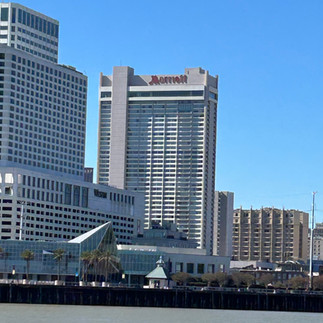
This view will ring a bell for the Olson family, we stayed at that Marriott and later set sail from this very dock on a cruise. Familiar ground, framed by river and memory.
And if you’re a coffee lover, you would’ve been in heaven the night we entered New Orleans. After a string of mishaps (detailed in the write-up), we found ourselves anchored just 200 yards from the Folgers coffee factory. The aroma was overwhelming, in the worst way. It felt like the river itself was brewing a fresh pot.



Hazel held her position for four long hours, patiently waiting for the traffic bridge to lift and the locks to open, our gateway into the industrial Causeway. It was a quiet pause before plunging into the mechanical heart of the river’s commerce.


As noted earlier, the four-hour delay forced us into nighttime travel, but fortune favored us. A full moon rose to guide our way, casting silver light across the water and softening the edges of an otherwise tense passage.
This is one of eight lift bridges that had to rise in tandem with lock operations to allow passage into, and out of, the industrial Causeway. A synchronized dance of steel and timing, making way for Hazel’s journey through the heart of river commerce.


Some additional photos :)




Hazel’s holding steady at her resting spot, awaiting the launch of leg two, our next chapter begins in early January.


Thanks for the thoughtful shots of PONO. I believe we are taking a shot at operating that dock. Hope it works out. Oh, and thanks for the full shots of Hazel. What a fine craft. A capable cruiser indeed. I’m excited you are at the end. Looking forward to your reports from the Gulf of America. God Bless you guys.