Panama Canal Transit Pt. 1
- Ingrid Molitor
- 7 hours ago
- 3 min read
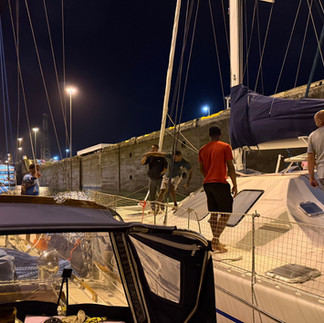
It’s Tuesday morning and we are scheduled to begin our transit from Shelter Bay Marina through the Panama Canal at 17:00. In the photos you will see that Hazel has a crew of seven to take on this undertaking: three line handlers, one advisor, Adriana, Peter, and me. Most of you know Hazel’s size. She is forty feet long with two places to sleep. Where will everyone sleep? The line handlers and the advisor expect to be fed two meals a day with drinks and snacks. All of them will be on Hazel for two days. That adds up to fourteen meals plus drinks and snacks. Hazel has a kitchen the size of a broom closet.
Back to the 17:00 departure. The canal sets the times and you have almost no say. Our 17:00 slot moved to 15:00, then moved again to 19:00. We left Shelter Bay at 14:30 to meet our advisor, who was supposed to be shuttled to us on a pilot boat at 15:00. We entered the bay just beyond the breaker wall and circled until he arrived at 16:00, only to be told that our time had been postponed to 19:00 and we should anchor in the bay and wait.
Peter handled the anchor while I stayed at the helm. Hazel is not easy to anchor. Her chain was kinked up in the chain locker and refused to feed into the water. Thanks to Peter’s hard work, we finally sorted it out and got our ground tackle on the seabed.
At 18:00 we received a radio call advising Hazel to proceed into the canal. As a pleasure craft, you generally are not allowed to transit solo. Before entering the locks we had to tie up and raft through with two other catamarans. The first three locks on the Caribbean side lift you twenty four meters into Lake Gatun, a fresh body of water that covers one hundred sixty eight square miles. For perspective, Lake Pepin is about forty square miles. Lake Gatun supplies all the locks with their water. You are not allowed to swim or sail on this lake for two reasons: it is full of crocodiles and it is heavily traveled by commercial vessels.
After locking through, we traveled about fifteen miles and tied up to a mooring for the night at 22:00.
During the trip the crew had to be fed, and the Darula family delivered all the meals. Dinner was rice, beans, and seared steak. An interesting fact: if the advisor does not like the meal being served, he has the right to radio a pilot ship and have food delivered from a restaurant at our expense. Our first advisor was named Lawrence. He was a good man and a good advisor. However, when speaking in Spanish with Adriana, he began to complain about the food. Peter, with his diplomatic way, quickly sorted him out, and by the end of Lawrence’s shift he was a happy man. It has become a theme, but Peter is an amazing camp chef.
What can go wrong when a small tribe of people is sleeping all over Hazel? A downpour of rain that drives everyone inside. I did not take any pictures, but I should have. There were legs and arms and bodies everywhere in Hazel’s cabin. My heart goes out to Adriana. Imagine trying to sleep with six men snoring, not in harmony, wet and smelly, all tucked into a confined space after a heavy bean dinner. You can picture it.
We followed a National Geographic vessel and I snapped a few shots of it. More about that vessel tomorrow along with the next part of our journey.
The Crew:


The National Geographic Vessel :

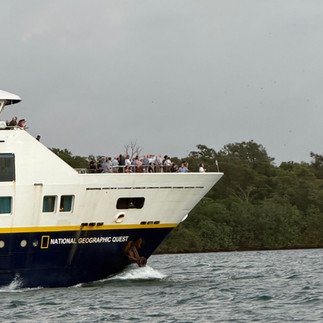


The bay marks the entrance to the canal, and this is where we anchored while waiting for our time slot. The bottom is scattered with sunken vessels left behind by past storms, a reminder of how unforgiving this stretch of water can be.


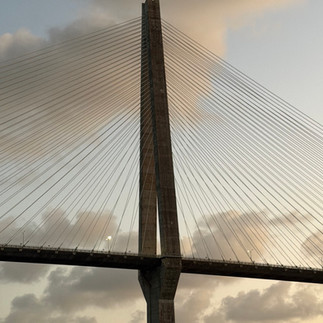
This is the first of three bridges we pass under as we move through the Panama Canal. This one is called the Atlantic Bridge.

Canal Locking: